
Drainage installation guide: do it yourself – guide to drainage renovation
Proper drainage installation – why it matters
A correctly executed drainage system protects a building’s foundations from moisture and extends the lifespan of its structures. A DIY drainage renovation can be successful when a clear and reliable installation guide is followed.
In this guide, we go step by step through how drainage pipe installation is done correctly—from excavation work to attaching damp-proof membranes and installing inspection wells. We also explain how deep drainage systems should be installed and why stormwater must never be directed into drainage pipes.
Key points from the article
Successful DIY drainage work depends on careful planning and the use of correct materials.
It is essential to ensure that proper slopes can be achieved for gravity-based water flow and that nothing obstructs drainage along the system.
Drainage pipes must be installed below the foundation level with a consistent slope—installation depth is a critical factor.
Drainage pipes are laid on top of filter fabric and a gravel layer to prevent clogging from soil particles.
Stormwater must never be connected to the drainage system—separate stormwater management is always recommended.
Drainage installation guide – 11 key steps
In this section, we go step by step through how a drainage renovation is carried out from start to finish using a DIY approach. By carefully following these eleven steps, you ensure that the drainage pipe installation and the entire drainage system function correctly and last for a long time.
1. Plan a functional drainage system
A survey of the building surroundings and soil conditions is essential before starting excavation. Ensure that proper slopes can be achieved using gravity and that water flow is not obstructed at any point.
2. Gather required materials and tools
Drainage pipes, filter fabric, damp-proof membrane, gravel, inspection wells, and backfill materials form the basic requirements. You will also need tools such as a shovel, measuring equipment, and possibly an excavator.
3. Excavate the drainage trench
The trench must be deep enough (typically 40–100 cm below the foundation level) and slope away from the building at least 1 cm per meter.
4. Install filter fabric on the trench base and sides
Geotextile fabric prevents fine soil particles from entering the drainage structure and extends the system’s lifespan.
5. Add a gravel layer on top of the fabric
A gravel layer (approximately 20–30 cm) beneath the drainage pipe ensures efficient water flow and prevents the pipe from sinking into the ground.
6. Install the drainage pipe in the correct position
A perforated drainage pipe can technically be installed in any orientation since it is perforated around the entire circumference. The key factor is maintaining a consistent slope and a stable base so that water flows efficiently.
7. Add gravel on top of the pipe
Add another 20–30 cm of gravel above the drainage pipe to create a permeable protective layer before closing the filter fabric.
8. Wrap the filter fabric over the gravel
The geotextile is folded over the gravel layer, forming a fully enclosed and filtered structure.
9. Install the damp-proof membrane against the wall
The membrane protects the foundation wall from soil moisture. Ensure it is installed correctly, tightly against the wall, and oriented properly.
10. Install inspection wells and connect pipes
Inspection wells allow monitoring and maintenance of the drainage system. Pipe lines are connected so that water flow remains unobstructed.
11. Backfill the trench with clean soil
Finally, complete the system by compacting the backfill soil and ensuring that slopes are not disturbed during filling.
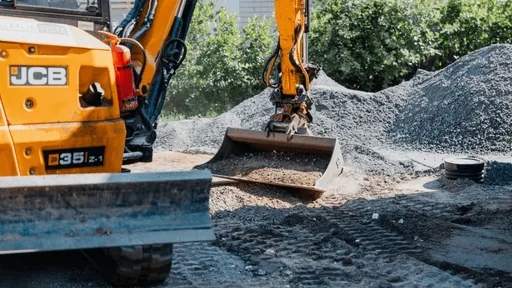
What to consider in a DIY drainage installation?
In a DIY drainage renovation, the most important factor is understanding how the drainage system works, the scope of the work, and its technical requirements. Pay special attention to safety when working in trenches, correct pipe slopes, and following drainage pipe installation guidelines consistently along the entire system.
Start by assessing the condition of the foundation, the slope of the yard, and the performance of any existing drainage system.
A drainage renovation is typically necessary if the foundation is damp, there is a musty smell in the basement, or rainwater accumulates around the building. In older houses, drainage systems may not exist at all or may have reached the end of their service life.
Costs should also be considered early in the planning phase, as they influence whether the project is suitable for DIY or should be handled by professionals. According to an earlier article, professional drainage renovation typically costs 14,000–22,000 euros, while a DIY project may range from 4,000–8,000 euros, depending on site conditions and equipment used.
If the project feels too large or time-consuming, it is always possible to request a quote from Salaojapiste.
At what depth should drainage pipes be installed?
The installation depth of drainage pipes depends on the building’s foundation depth and soil conditions. A general guideline is that drainage pipes are installed approximately 40–100 cm below the foundation level. This ensures that moisture does not rise into the structure through capillary action.
Depth is a critical factor in a functioning system—pipes installed too high will not drain water effectively. The slope, typically around 1%, must also be carefully maintained during installation.
What is placed around drainage pipes?
Drainage pipes are surrounded by a layer of washed gravel (approximately 20–30 cm on all sides and above the pipe), which allows water to flow freely into the pipe.
In addition, the entire structure is wrapped in filter fabric, which prevents fine soil particles from entering the drainage system and clogging it.
Proper layering is essential for an efficient and long-lasting drainage system.
As Timothy Dale describes a similar system known as a French drain:
A drainage system consists of a perforated pipe placed at the bottom of a trench and surrounded by gravel and filter material to prevent soil particles from entering the pipe.
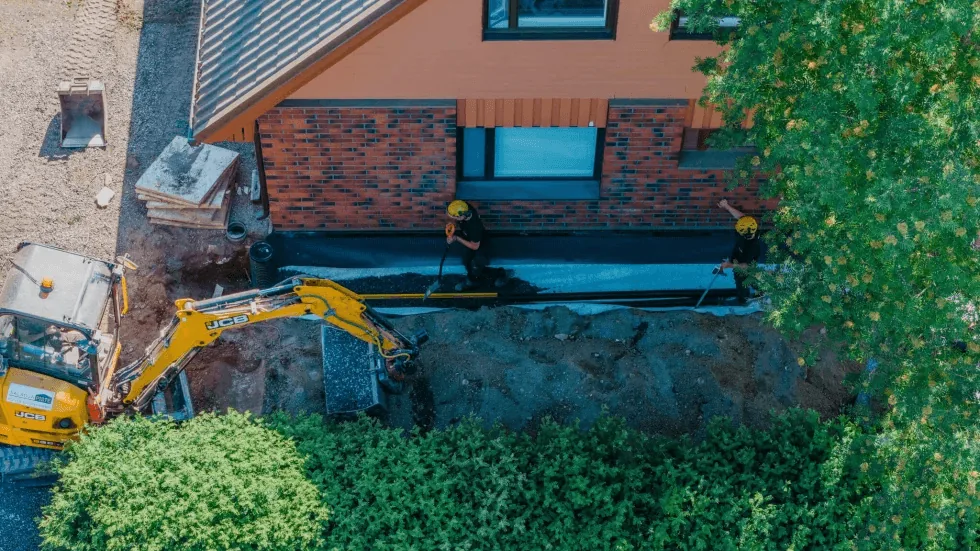
How should a drainage pipe be installed underground?
A perforated drainage pipe can be installed in the ground in any orientation because the holes are evenly distributed around the entire pipe. The most important thing during installation is to ensure that the pipe rests on a stable, even base and follows the planned slope, typically about 1 cm per meter. This allows water filtering from the soil to efficiently enter the pipe and flow away from the building’s foundation. If the pipe is installed incorrectly, it will not function as intended and may lead to moisture problems.
How much gravel is needed for drainage?
The amount of gravel depends on the trench dimensions, but generally 20–30 cm of gravel is recommended below and above the pipe. This corresponds to approximately 0.5–0.7 m³ of gravel per meter of drainage line. For example, if you run a 40-meter perimeter around a building, you will need about 20–30 m³ of gravel.
How is a foundation drainage board (dimple board) installed correctly?
When installing a foundation drainage board, the most important factor is correct orientation—dimples facing the foundation wall—and ensuring it extends above ground level. The top edge of the board can be finished with a trim strip to prevent splash water and debris from getting between the wall and the board.
The installation of the drainage board was previously described as follows:
The drainage board is attached to the foundation wall with nails or screws so that it stays firmly in place. Proper installation ensures that the board’s textured surface prevents water from reaching the foundation and directs it correctly toward the drainage system.

Is a drainage inspection chamber mandatory?
Inspection chambers are not always legally required, but they are a highly recommended part of a properly functioning drainage system. They allow for inspection and flushing of the drainage system in case of blockages or sediment buildup. They are especially useful at junctions, building corners, and long pipe runs where maintenance would otherwise be difficult.
According to a guide on the subject, inspection or sedimentation chambers should be installed at low points and connection areas to ensure that system maintenance is easy and effective.
Why must rainwater not be directed into drainage pipes?
Rainwater must not be directed into drainage pipes because the drainage system is designed to remove groundwater from the soil, not large volumes of surface water. If rainwater is introduced into the system, it becomes overloaded and water flow slows down. This can cause the inspection chamber to fill quickly and create pressure in the pipe network. As a result, it may lead to overflow, moisture rising into structures, or even water damage.
The best solution is to implement a separate stormwater system, where roof and surface water is directed into stormwater drains, ditches, slopes, infiltration fields, or a municipal stormwater network.
Summary
A do-it-yourself drainage renovation is successful when clear installation guidelines are followed and proper attention is given to pipe installation, material selection, correct depth, and slope. A properly executed drainage system prevents moisture damage and extends the lifespan of the building. Always separate stormwater from drainage pipes and ensure proper installation of foundation drainage boards and inspection chambers. If the project feels challenging, Salaojapiste can help – request a quote here.
Lähteet
Salaojapiste – Milloin talon salaojitus kannattaa uusia? – 7 selvää merkkiä
Salaojapiste – Salaojaremontin hintaopas – Mitä salaojaremontti maksaa 2025
Salaojapiste – Patolevyn asennus – Näin vältät kalliit virheet
Salaoja Piste – Salaojaremontti – 10 tärkeintä kysymystä