Drainage system structure – 7 key components of a functional system
Drainage systems – why they are important
Drainage systems are a hidden but essential part of a building’s functionality. Their purpose is simple: to redirect excess groundwater away from the foundations before it can cause problems.
When drainage systems work properly, they usually go unnoticed. However, if the system is insufficient or incorrectly installed, problems can appear surprisingly quickly.
Proper attention should be given to the structure of the drainage system from the very beginning. In this article, we go through the seven most important components of a drainage system and explain what should be considered during installation.
Key points from the article
The purpose of a drainage system is to direct excess groundwater away from the foundations.
Without proper drainage, moisture can rise from the soil into the structure, potentially causing mold problems, poor indoor air quality, and even structural damage to the foundation.
A functioning drainage system consists of multiple complementary layers and components that must be installed in a precise order.
A properly built and regularly maintained drainage system can last 30–50 years at its best.
Successful drainage installation requires careful planning, suitable materials, and a solid understanding of how drainage systems function and the correct installation sequence.
What is the purpose of a drainage system?
The purpose of a drainage system is to redirect excess groundwater away from a building’s foundations and structural elements.
As described in an earlier article:
“Well-executed drainage ensures the breathability of the foundation and guarantees that rainwater and meltwater are directed to the correct place.”
This prevents moisture from accumulating in the plinth, basement areas, and foundations, thereby reducing the risk of moisture damage, mold growth, structural deterioration, and frost-related damage. A properly functioning drainage system improves the building’s overall health and durability and significantly extends its lifespan.
Is drainage necessary?
A common question is whether drainage systems are actually required. In practice, drainage is almost always essential.
Without drainage, moisture can rise from the soil into the structure, leading to mold problems, reduced indoor air quality, and even foundation damage.
As noted in an earlier article:
“Drainage is especially important in areas with heavy rainfall, high groundwater levels, or clay soil with poor water permeability. Drainage systems prevent water from entering the building foundations, protecting structures from moisture damage, mold, and other deterioration.”
On sandy or highly permeable soil, drainage may be less critical, but it is still almost always installed as a precaution.
What does a drainage system consist of?
A functional drainage system is made up of several complementary layers and components that must be installed in a precise order. This ensures that water is efficiently directed away from the building’s foundations in a controlled manner.
Many people also wonder how deep drainage systems are installed and what slope is required.
Installation begins with excavation: soil is dug around the building, old drainage systems are removed if present, and the condition of the foundation is inspected.
In a typical residential project, the trench is approximately 70–100 cm deep and 50–70 cm wide. However, depth can vary significantly depending on the foundation level—basements may require excavation depths of up to 3 meters.
At the bottom of the trench, a level base with a slight slope is formed for the drainage pipes. The drainage pipes should have a gradient of at least 1–2% toward the collection well to ensure proper water flow.
1. Drainage pipes – how drainage pipes work
Drainage pipes are the core of the system. They collect water moving through the soil and guide it in a controlled way to a main inspection well or stormwater drainage system.
The pipes are perforated plastic pipes installed below the building foundations, slightly sloped to ensure proper flow. As described in an earlier article:
“Today most underground drainage systems are made from PVC plastic, which is durable and practically maintenance-free.”
Correct placement prevents water from accumulating beneath the foundations and enables effective drying of the surrounding soil.
2. Gravel – the water-permeable protective layer
A common question is what goes around drainage pipes. The pipes are carefully surrounded by gravel, which helps guide water toward the pipes and prevents them from sinking into the soil.
The typical grain size of the gravel is 8–16 mm.
You may also wonder how much gravel is needed. A minimum of 20–30 cm is added around the pipes, and it must be clean and highly permeable. This layer ensures fast water movement into the drainage system.
3. Drainage filter fabric – protection against clogging
A filter fabric is installed on top of the gravel layer, separating coarse gravel from finer soil materials. Its purpose is to prevent soil particles from entering the gravel layer and pipes, which reduces clogging and extends the system’s lifespan.
The fabric is wrapped tightly around the gravel layer, with overlaps carefully sealed to ensure continuity.
4. Drainage frost insulation – protection against freezing and frost heave
Frost insulation boards (such as XPS or EPS boards) are installed above the drainage system, typically at a depth of around 40–50 cm.
Their purpose is to prevent the soil around the drainage system from freezing, which could otherwise block pipes and cause frost damage to the foundation.
The boards are installed in overlapping layers and extended at least 1–2 meters away from the building, with a gentle slope away from the structure.

5. Damp-proof membrane and drainage insulation boards (Pordrän) – moisture protection for foundations
A drainage membrane is primarily installed against the foundation wall, creating an air gap between the wall and the backfill soil. This air gap prevents moisture from coming into direct contact with the structure.
As noted in an earlier article, the membrane is installed with the studs facing the wall and is protected at the top with a finishing strip.
In basement structures, we additionally always install Pordrän boards on top of the membrane. Pordrän is a drainage and thermal insulation board that functions both as a moisture control layer and as insulation.
This creates a multi-layer protection system that improves both moisture management and energy efficiency.
6. Inspection wells and main sump pit – system maintenance points
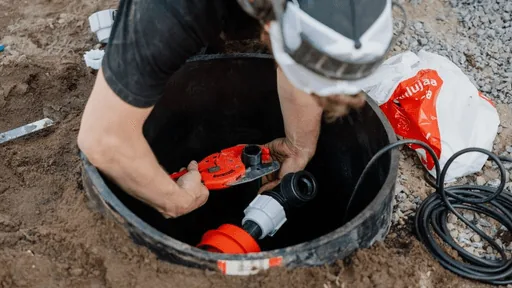
Drainage pipes are connected to inspection wells, which are installed at building corners and along longer pipe runs. These wells allow the system to be monitored and the pipes to be flushed when necessary.
A common question is where drainage water is ultimately directed.
Drainage systems typically discharge water either into an open ditch or a slope, or alternatively into a main sump pit, which collects the water and directs it further into a stormwater sewer or infiltration system.
If there is insufficient natural slope, a pump pit is installed to mechanically transfer water away from the property.
7. Backfill layers and surface grading – finishing and water direction
Once the technical layers are installed, the trench is backfilled in layers.
Gravel is placed over the filter fabric, acting as both a load-bearing and water-conducting layer. Finally, topsoil such as sand or garden soil is added.
The surface grading must always slope away from the building so that rainwater does not accumulate near the foundation.
A properly finished drainage system is both highly effective and visually unobtrusive in the yard.

How long do drainage systems last?
The lifespan of drainage systems varies depending on the materials used, how the system has been installed, and the soil conditions in which it operates.
At best, a properly built and regularly maintained drainage system can last 30–50 years.
Over time, plastic pipes can become brittle, and older concrete pipes may start to crumble or become clogged even earlier. If the system has been poorly constructed or maintenance has been neglected, its performance can degrade significantly faster.
Can drainage installation be done as a DIY project?
Drainage installation can be done as a DIY project if you have sufficient construction knowledge, time, and the necessary tools.
Successful execution requires careful planning, suitable materials, and a solid understanding of how drainage systems work and the correct installation sequence.
As stated in an earlier article:
“Although a DIY renovation may seem like a cost-effective solution, relying on professional help ensures that the work is done correctly and in a durable way. Improperly installed drainage can lead to serious moisture problems, the repair of which can become very costly over time.”
Mistakes in slope, filtration, or insulation can result in a system that does not function properly or exposes the building to moisture damage.
Lähteet
Patolevyn asennus -Näin vältät kalliit virheet
Voiko salaojaremontin tehdä itse?
Salaojaremontti –10 tärkeintä kysymystä
Milloin talon salaojitus kannattaa uusia? – 7 selvää merkkiä